Kitesurfing injuries: how to prevent, recognise and treat them — a foot & ankle surgeon's guide to Ceará
By Dr. Caio Fábio — orthopaedic foot & ankle surgeon (CRM-CE 12791 · RQE 8590) · Published 1 September 2026
Quick answer
The injuries most often reported in kitesurfing are cuts and abrasions, ankle sprains and foot or ankle fractures, rib injuries and knee ligament injuries; among joint and bone injuries, the foot and ankle are the most frequently affected region (Nickel et al., 2004; van Bergen et al., 2020; Offerhaus et al., 2026).
In the first days, protect the area, avoid forcing weight through it, and hold off on anti-inflammatory medication until you have been assessed (Dubois & Esculier, 2019).
Go to an emergency room the same day if there is visible deformity, you cannot take four steps on the foot, you have numbness, or there is an open wound. Book a consultation for pain, swelling, or instability that does not fit those signs but also does not settle within a few days.
Why Ceará: wind season, beginners and visitors
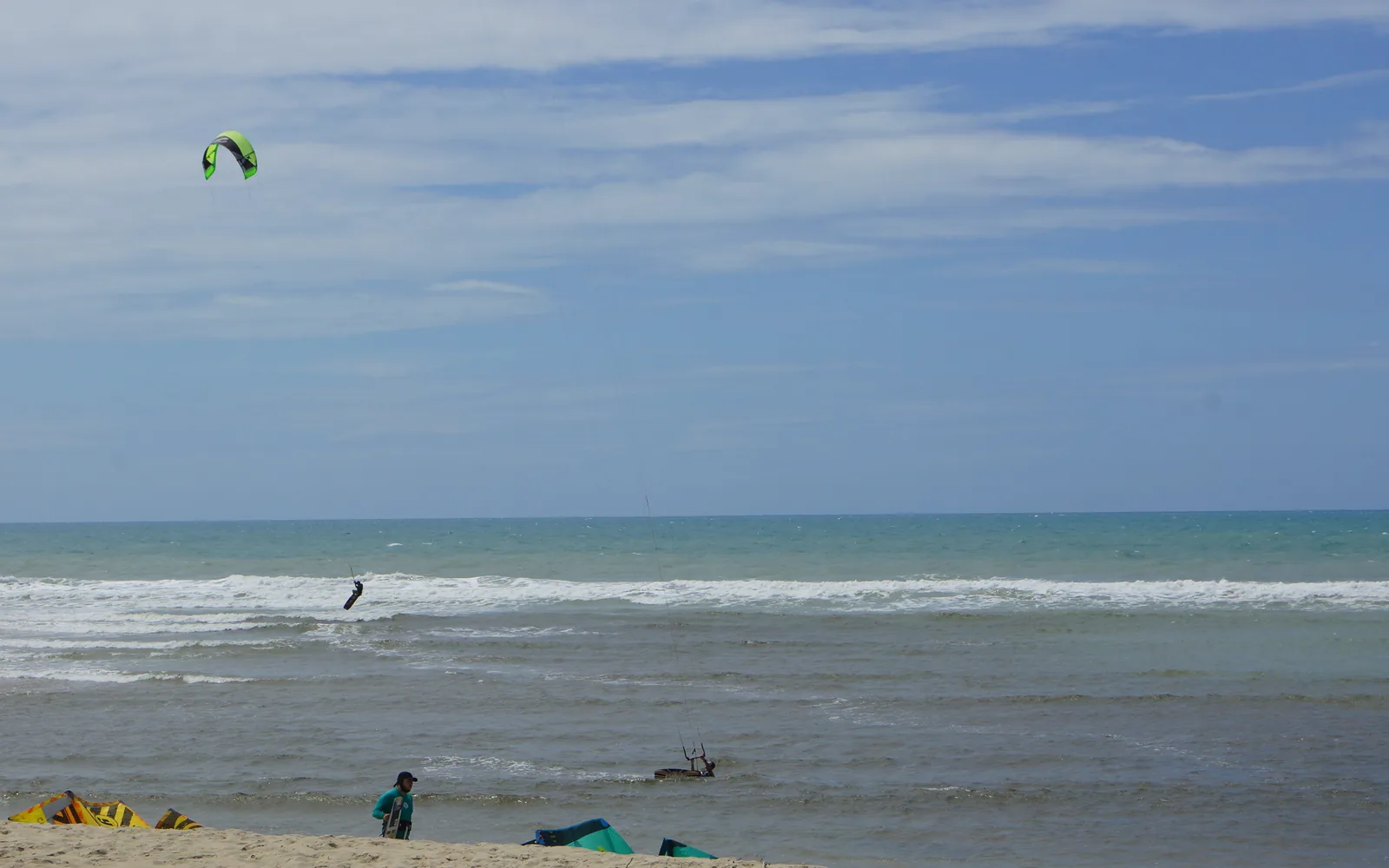
Ceará's coastline — Cumbuco, Taíba, Paracuru, Preá and Jericoacoara, and Barra Grande just across the state line in Piauí — is one of the more consistent kitesurfing destinations in the world, with a wind season that runs roughly from July through January. Kite schools operate along the coast, and a large share of the people riding at any given time are visitors: beginners on their first lessons, intermediate riders progressing quickly in strong, steady wind, and experienced kiters pushing bigger jumps and tricks.
That mix of skill levels, unfamiliar terrain, and long days on the water is exactly the combination the research below points to as the main driver of risk — inexperience, fatigue, and unfamiliar conditions, more than the sport itself.
If you are injured during a trip, getting evaluated does not have to mean navigating an unfamiliar healthcare system in a language you do not speak. Consultations in English are available in Fortaleza (Meireles) and in Eusébio — see the English information page for the practical side of visiting as a foreigner — and if you have already flown home before every question is answered, a video follow-up can usually pick up where the in-person visit left off (see teleconsulta, in Portuguese).
What the research shows
Kitesurfing has been studied more than most board sports, and the findings are reasonably consistent from one country to the next. Here is how six of the main studies compare:
| Study | Who was studied | Injury rate | Most affected |
|---|---|---|---|
| Nickel et al., 2004 | 235 kitesurfers, 6 months | 7 / 1,000 hours | Foot & ankle (28%) |
| van Bergen et al., 2020 | 194 kitesurfers, 1 season | 10.5 / 1,000 hours | Foot & ankle (31.8%) |
| Offerhaus et al., 2026 | 3,138 athletes, 3,720 major injuries | 4.8 / 1,000 hours | Cuts & abrasions (23%) |
| Beer et al., 2024 | 312 kiteboarders | 7.82 / 1,000 sessions | Knee (24.1%) |
| Debieux et al., 2026 (Brazil) | 442 kitesurfers, ages 18–70 | 66.6% ever injured | Knee, foot or ankle |
| Crimmins et al., 2025 (review) | Review of 25 articles | Varies by study design | Below the knee (~50%) |
Reported injury rates cluster in a range that sits alongside contact sports rather than above them (Bourgois et al., 2014; Baumbach et al., 2017). Skill level is the factor that shows up again and again as decisive: in the largest recent survey, beginners were injured at 65 per 1,000 hours, against 1.1 per 1,000 hours for professionals (Offerhaus et al., 2026), and less experienced athletes were consistently found to be at higher risk in other cohorts too (Beer et al., 2024; Bockmann et al., 2024).
One Brazilian survey seems to show the opposite: more injuries reported among experienced and advanced riders (Debieux et al., 2026). That is not a contradiction — it is a difference in what was measured. Most studies above count injuries per hour of riding, which favours beginners, who simply log fewer hours. The Brazilian survey instead asked whether a rider had ever been injured, a question that experienced riders — with many more seasons behind them — are naturally more likely to answer yes to. Both findings can be true at once.
How injuries happen
Landings account for a large share of injuries. A failed kiteloop — where the kite does not behave the way the rider expects on the way down — produces higher landing loads and acceleration than a successful one, described by researchers as the kite briefly losing its "parachute effect" (Simons et al., 2025). Measured landing forces in kitesurfing and wakeboarding have reached as much as 3,012 N, and riders in fixed boots absorb higher forces through the leg than riders in straps, which allow a little more give (Sander et al., 2024).
Not being able to release the kite quickly was flagged as a factor in over half of injuries in one of the earliest studies, which found a tendency toward fewer injuries among kitesurfers using a quick-release system (Nickel et al., 2004) — though a more recent study found the release system made no measurable difference (Bockmann et al., 2024). The two have not been reconciled; both are reported here as they stand.
Loss of control close to the beach is another recurring mechanism — technical mistakes, an oversized kite, or gusty onshore wind pushing a rider into sand, rocks, or a boat (Petersen et al., 2002) — consistent with a Brazilian survey that found most injuries happened while training within 50 metres of the shore (Debieux et al., 2026). In Norway, operator error or lack of experience was identified as a contributing factor in 82% of injuries (Torland et al., 2024).
Ankle sprain: the number-one foot injury in kiting
The classic kitesurfing ankle sprain happens when the foot, still strapped or booted to the board, rolls inward on landing while the rest of the body keeps moving — an inversion injury. Sprains are graded I to III by how much ligament is torn, and most grade I–III sprains are managed without surgery (Petersen et al., 2013).
In the first days, the evidence-based framework is PEACE & LOVE: Protection, Elevation, Avoiding anti-inflammatory medication, Compression, and Education in the acute phase, followed by Load, Optimism, Vascularisation, and Exercise as it settles (Dubois & Esculier, 2019). Prolonged immobilisation is discouraged; even a grade III sprain is typically splinted only briefly — up to about ten days — before moving into a semi-rigid brace (Petersen et al., 2013).
What happens after the acute phase matters as much as the sprain itself: an ankle that is not properly rehabilitated tends to stay unstable, setting a rider up for the next sprain. Balance and proprioceptive training has been shown to cut ankle sprain incidence by 38% in athletes generally (de Vasconcelos et al., 2018), and bracing after a previous sprain has strong evidence behind it for preventing a repeat injury (Doherty et al., 2017; Petersen et al., 2013).
Fractures: when it is not "just a sprain"
Two fracture patterns come up repeatedly in kitesurfing: a crack at the base of the fifth metatarsal, on the outer edge of the foot, and — less often but more seriously — fractures around the ankle itself, including a bimalleolar ankle fracture reported in one prospective cohort (van Bergen et al., 2020). Across major kitesurfing injuries generally, foot and ankle fractures account for around 5% of cases (Offerhaus et al., 2026).
The findings that separate a fracture from a sprain are not something you can reliably judge yourself on the beach. Seek an X-ray the same day if there is bone tenderness right over either ankle bone or over the base of the fifth metatarsal, if you cannot take four steps on the foot right after the injury, if there is visible deformity, or if there is numbness or a cold, pale foot. Swelling and bruising alone, without those signs, are common in sprains too and do not by themselves mean a fracture.
Achilles, heel pain and overuse
Not every kitesurfing injury comes from a single fall. Repeated hard landings, session after session, load the Achilles tendon and the heel in a way that adds up over time rather than all at once (Sander et al., 2024; Bourgois et al., 2014). Pain and stiffness at the back of the heel that builds gradually — worse after riding, better with rest — is the typical pattern of an overuse injury rather than an acute one, and it typically responds better to a gradual, progressive return to load than to complete rest followed by a sudden jump back to full sessions.
Beyond the foot: cuts, ribs, knee and head
Not every kitesurfing injury involves the foot or ankle. Across full studies, cuts and abrasions are usually the single most common injury type overall — 25.4% of injuries in one cohort and 23% in another, more recent one (van Bergen et al., 2020; Offerhaus et al., 2026) — typically from the board, fins, or the sandy bottom rather than anything more serious.
Rib injuries make up about 12% of major injuries (Offerhaus et al., 2026), usually from direct impact with the board or the water at speed. Knee ligament injuries are less common but matter disproportionately: they cause the longest time away from the sport of any injury type (Offerhaus et al., 2026), and ACL reconstruction is the single most frequent surgery among kiteboarders who needed an operation (Beer et al., 2024).
Head injuries, including concussion, are also reported consistently across studies (Torland et al., 2024); in one of the earliest kitesurfing injury studies, none of the riders with head injuries in that cohort had been wearing a helmet (Nickel et al., 2004).
On the beach, right after the injury
What you do in the first few minutes matters less than getting it right, not fast. Get out of the water and off the kite lines safely first. Do not try to walk it off if bearing weight is sharply painful; do not take anti-inflammatory tablets or gels on your own in the first days — they may interfere with the early healing response (Dubois & Esculier, 2019) and should be used only under medical guidance; and do not wait days "to see if it gets better" if any of the red flags above apply to you. Beyond that, the sequence that follows an injury is fairly predictable, even though the details — what imaging, what brace, how long — are always decided case by case.
What the path after an injury usually looks like
- Stop the activity and get safely off the water and away from the kite lines.
- Protect the injured area and avoid putting weight on it if it's painful to do so.
- Get an in-person evaluation, especially if any red flag from the sections above is present.
- Have imaging — X-ray or ultrasound — if the exam suggests it's needed.
- Follow a brace, activity-modification, or, less often, surgical plan based on what the exam and imaging actually show.
- Work through a structured rehabilitation program rather than stopping once the pain is gone.
- Return to kitesurfing based on function, not the calendar (see below).
General steps, for orientation. The exact sequence, timing, and indications are decided case by case, at the evaluation.
Prevention: what the evidence supports
Not all prevention advice carries the same weight. Some measures are backed by consistent findings across several studies; others are plausible but only lightly tested. Here is how the evidence breaks down:
| Measure | Strength of evidence | What studies show |
|---|---|---|
| Lessons and progression by skill level | Consistent | Skill level is the most repeated risk factor; beginners injured far more often than professionals (Offerhaus et al., 2026; Beer et al., 2024; Torland et al., 2024; Bockmann et al., 2024). |
| Balance / proprioceptive training | Favourable | Reduced ankle sprain incidence by 38% in athletes generally (de Vasconcelos et al., 2018); moderate-quality evidence for preventing recurrence (Doherty et al., 2017). |
| Ankle brace after a previous sprain | Consistent | Strong evidence for preventing another sprain (Doherty et al., 2017; Petersen et al., 2013). |
| Quick-release system & board leash | Inconsistent | A tendency toward fewer injuries with a quick-release in one study (Nickel et al., 2004) was not confirmed in another (Bockmann et al., 2024); leash use was one factor linked to injury rate in a third (Baumbach et al., 2017). |
| Warm-up | Limited | One of several factors associated with injury rate in a single study (Baumbach et al., 2017). |
| Helmet / impact vest | Limited but plausible | None of the head injuries in one cohort involved a helmet (Nickel et al., 2004); protective gear is uncommon among kitesurfers generally (Crimmins et al., 2025). |
| Landing with the kite in the right position | Limited, lab study | Failed kiteloops produced higher landing loads and acceleration than successful ones in a small sensor-based study (Simons et al., 2025). |
| Sunscreen | Outside orthopaedics, but worth noting | 84.7% of elite kitesurfers had at least one sunburn in a season (de Castro Maqueda et al., 2022). |
Where the evidence is inconsistent — quick-release systems are the clearest example — it is worth using the safety equipment as designed without assuming it eliminates risk on its own.
Getting back on the water: criteria, not a calendar
There is no universal number of weeks that applies to every ankle sprain, fracture, or knee injury — recovery is judged by criteria, not a date on the calendar. In general, that means being pain-free during normal activity, having regained strength that is symmetric with the uninjured side, having balance and proprioception back to a level you trust, and being able to perform landing and loading drills on land confidently before doing them on the water again.
For context, not as a promise about your own timeline: in one study comparing kitesurfing and windsurfing injuries treated at a North Sea hospital, the median time to return to kiting was about four weeks, and roughly a third of those injured still had some chronic symptoms afterward (van Bergen et al., 2016). That second number is exactly why the rehabilitation step above is not optional — it is the difference between a sprain that heals and one that keeps coming back.
If you get injured in Ceará: how a consultation works
In-person evaluation is available at two locations: Clínica Qorpo, in Meireles, Fortaleza (Av. Senador Virgílio Távora, 195, Meireles, Fortaleza/CE, 60170-265), and Odonto Med Clinic, Sala 201 — Medical Center Eusébio, in Eusébio (Av. Eusébio de Queiroz, 4808, Centro, Eusébio/CE, 61760-051). Both have on-site parking. The consultation itself — history, physical exam, and the explanation of what is going on and what the options are — is conducted in English.
Imaging is arranged when the exam calls for it: X-ray for a suspected fracture, or in-office ultrasound for a tendon or soft-tissue injury, without needing a separate appointment elsewhere. If you have already left Brazil before treatment is finished, a video follow-up can continue the plan from wherever you are (see teleconsulta, in Portuguese).
For what to expect at a first visit, see the primeira consulta page (in Portuguese).
Scientific references (19)
- Nickel C et al. (2004). A prospective study of kitesurfing injuries. The American Journal of Sports Medicine. DOI 10.1177/0363546503262162
- van Bergen CJA et al. (2020). Kitesurf injury trauma evaluation study: a prospective cohort study evaluating kitesurf injuries. World Journal of Orthopedics. DOI 10.5312/wjo.v11.i4.243
- van Bergen CJA et al. (2016). Windsurfing vs kitesurfing: injuries at the North Sea over a 2-year period. World Journal of Orthopedics. DOI 10.5312/wjo.v7.i12.814
- Offerhaus C et al. (2026). Injuries in kitesurfing: a retrospective cross-sectional survey on injury patterns based on discipline and skill level, considering time loss and performance reduction. BMC Sports Science, Medicine and Rehabilitation. DOI 10.1186/s13102-026-01551-w
- Debieux P et al. (2026). Epidemiology of injuries in kitesurfing. The Journal of Sports Medicine and Physical Fitness. DOI 10.23736/S0022-4707.25.16968-5
- Crimmins A et al. (2025). How safe is kitesurfing? A review of orthopaedic kitesurfing injuries. Irish Journal of Medical Science. DOI 10.1007/s11845-025-03956-x
- Bourgois JG et al. (2014). Biomechanical and physiological demands of kitesurfing and epidemiology of injury among kitesurfers. Sports Medicine. DOI 10.1007/s40279-013-0103-4
- Beer Y et al. (2024). Kiteboarding Injuries: Epidemiology, Common Treatment Strategies, and Time to Return to Kiteboarding Following Injury. Clinical Journal of Sport Medicine. DOI 10.1097/JSM.0000000000001270
- Simons S et al. (2025). Load Analysis of Kitesurfing Jumps: Is Kite Position Rather Than Jump Height More Crucial for Landing Impact Protection? Orthopaedic Journal of Sports Medicine. DOI 10.1177/23259671251369017
- Sander F et al. (2024). In-vivo stress measurements in kitesurfing and wakeboarding: implications on load control and preventive approaches. Sportverletzung Sportschaden. DOI 10.1055/a-2438-8740
- Bockmann B et al. (2024). Influence of equipment choice and athletic experience on the incidence of kitesurfing injuries: a prospective observational study. Journal of Bodywork and Movement Therapies. DOI 10.1016/j.jbmt.2024.10.036
- Baumbach SF et al. (2017). Influence of kitesurf equipment on injury rates. The Journal of Sports Medicine and Physical Fitness. DOI 10.23736/S0022-4707.17.07152-3
- Torland V et al. (2024). Kitesurfing and snowkiting injuries in Norway: a retrospective study. BMC Sports Science, Medicine and Rehabilitation. DOI 10.1186/s13102-024-00812-w
- Petersen W et al. (2002). Mechanisms and prevention of kitesurfing injuries [article in German]. Sportverletzung Sportschaden. DOI 10.1055/s-2002-34751
- Doherty C et al. (2017). Treatment and prevention of acute and recurrent ankle sprain: an overview of systematic reviews with meta-analysis. British Journal of Sports Medicine. DOI 10.1136/bjsports-2016-096178
- de Vasconcelos GS et al. (2018). Effects of proprioceptive training on the incidence of ankle sprain in athletes: systematic review and meta-analysis. Clinical Rehabilitation. DOI 10.1177/0269215518788683
- Petersen W et al. (2013). Treatment of acute ankle ligament injuries: a systematic review. Archives of Orthopaedic and Trauma Surgery. DOI 10.1007/s00402-013-1742-5
- de Castro Maqueda G et al. (2022). Sun Exposure and Photoprotection: Habits, Knowledge and Attitudes Among Elite Kitesurfers. Journal of Cancer Education. DOI 10.1007/s13187-020-01838-7
- Dubois B & Esculier JF (2019). Soft-tissue injuries simply need PEACE and LOVE. British Journal of Sports Medicine. DOI 10.1136/bjsports-2019-101253
References were checked against their indexed publication before this page was written. This summary is written for general understanding; reading the original studies is recommended for technical depth.
Frequently asked questions
Is kitesurfing dangerous?
Kitesurfing carries a real injury risk, with published rates in a range similar to other contact and board sports — roughly 5 to 18 injuries per 1,000 hours, depending on the study (Bourgois et al., 2014; Baumbach et al., 2017). Risk is strongly tied to skill level: beginners are injured far more often than experienced riders (Offerhaus et al., 2026).
What is the most common kitesurfing injury?
Overall, cuts and abrasions are usually the single most frequent injury type (van Bergen et al., 2020; Offerhaus et al., 2026). Among joint and bone injuries specifically, the foot and ankle — especially ankle sprains — are consistently the most affected area (Nickel et al., 2004; van Bergen et al., 2020).
I twisted my ankle kiting — do I need an X-ray?
Not always, but see a doctor the same day if you have bone tenderness over either ankle bone or the base of the fifth metatarsal, can't take four steps on the foot, notice deformity, or have numbness. Without those signs, it may be a sprain that a hands-on exam can assess first.
Straps or boots: which protects the ankle?
The two aren't simply safer or riskier — they load the ankle differently. Fixed boots have been measured transmitting higher landing forces to the leg than straps, which allow a little more give on impact (Sander et al., 2024). Neither has been shown to reliably prevent injury on its own.
How long until I can ride again?
It depends on the injury and how you respond to rehabilitation, not on a fixed number of weeks — return is based on being pain-free and regaining symmetric strength and balance. As a general reference point, one study found a median return to kiting of about four weeks (van Bergen et al., 2016).
I'm a foreigner injured in Ceará — how does the consultation work?
You can be seen in person at Clínica Qorpo (Av. Senador Virgílio Távora, 195, Meireles, Fortaleza/CE, 60170-265) or at Odonto Med Clinic, Sala 201 — Medical Center Eusébio (Av. Eusébio de Queiroz, 4808, Centro, Eusébio/CE, 61760-051), both with on-site parking. History, exam, and the explanation of your diagnosis and options are conducted in English. If you fly home before every question is answered, a video follow-up can continue from there.
Injured kitesurfing in Ceará?
Message us on WhatsApp in English and we will help you plan your evaluation.
This page is for informational purposes only and does not substitute an in-person medical consultation.